
Jevons only knows
If AI makes your industry more efficient, what happens to demand – and to your job?
In mid-19th century Britain, deep in the throes of the industrial revolution, there was a pressing question: there was only so much coal in the world, so how did you avoid running out of it? Coal was what had made industry possible, “the material energy of the country, the universal aid, the factor in everything we do.” Running out would be a total disaster.
Many people thought the answer was to make the things that used coal more efficient, so they could achieve the same output while using less coal. By doing that, they thought, you’d ease the demand for coal, and allow the limited reserves to last for longer.
In his 1865 book The Coal Question, the economist William Stanley Jevons took the opposite view. Increasing the efficiency of coal wouldn’t reduce demand for it, Jevons said; in fact, it would have the opposite effect. If you ran a factory on coal, and some new technology made your factory significantly more efficient, you wouldn’t respond by making the same amount of stuff in less time; you’d make more stuff, more cheaply, and use more coal in the process. If you made coal more efficient in the hope that people would use less of it, Jevons said, you were in for a nasty surprise.
This is the Jevons paradox: a situation where an increase in efficiency of something creates so much more demand for it that any effect of the increased efficiency is wiped out. It requires:
- The efficiency of the thing to be capable of being improved as the result of new technology
- Improvements in efficiency to lead to lower prices for the consumer (i.e. no monopolies or general supplier bargaining power that means suppliers capture the surplus)
- Lower prices to lead to much greater demand from the consumer (i.e. demand to be highly elastic)
Coal is the textbook example, but think of computing. Computers are thousands of times more powerful – per watt of power or dollar of cost – now than they were in, say, 1990. But we haven’t responded to that improvement by simply running the same computer programs as we did then, only hundreds of times more quickly and cheaply. Instead, many more possibilities for computerisation have been opened up by the fact that computing power is now much cheaper. We’ve put computers into fridges, wristwatches, cars and children’s toys; we’ve computerised millions of processes that previously took place in person or on paper; we’ve found countless little corners of the economy that we can shove computers into. We use far more computing power nowadays than in 1990 precisely because computers are more efficient now. Conditions 1, 2 and 3 apply; it’s the Jevons paradox.
On the other hand, you might think of the farming industry. In the UK in 1860, agriculture employed nearly a quarter of the population. Since then, it’s become much, much more productive: feeding the country in 2025 requires us to employ only about one per cent of the population in agriculture, and food in general is much cheaper in real terms. But what we haven’t seen is an explosion of demand for this cheaper, more efficiently produced food. It turns out that demand for food is pretty inelastic; in developed countries we do tend to eat too much, but we don’t respond to a significant decrease in the price of food by eating much more of it. Conditions 1 and 2 hold, but not condition 3. And so while agriculture was 20% of UK GDP in 1860, it was 7% by 1913 and is now just 0.6%.
The Jevons paradox has been enjoying some time in the spotlight in the last couple of years, thanks to our old friend AI. It’s sometimes used with reference to AI itself (i.e. that as AI becomes cheaper, we’ll use more of it). But lots of people, many of them the executives of AI companies, suggest that the Jevons paradox will apply to industries affected by AI: that AI will increase efficiency, but that this will lead to industries growing rather than being destroyed.
You can see how this could be either wishful thinking or a cynical distraction technique on the part of AI executives. But for those of us outside the AI industry itself, this line of reasoning suggests a pressing question. Could it potentially be true of your industry, and what would that mean for you? Is your particular industry likely to end up like computing, or like agriculture? And if it does look like computing, and so is subject to the Jevons paradox, what does that mean for employment within the industry – rather than just overall demand and output? After all, things might grow significantly and create a rosy picture for GDP, but without the need for pesky human beings.
The criteria that matter are:
-
Could AI lead to the Jevons paradox in this industry? That is, could AI potentially increase efficiency in a way that lowers prices and unleashes previously suppressed demand, so that overall demand increases?
-
Will there be a significant role for humans left in the post-AI version of this industry? Will humans be merely augmented by AI, or replaced by it?
The answers to those questions implies a 2×2. One axis reflects what happens to demand for a given industry, and the other reflects what happens to the human beings working in it:
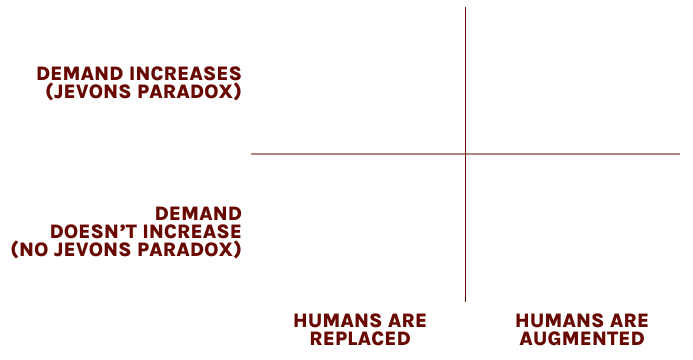
In the bottom-left quadrant, the industry remains on its existing growth trajectory – there’s no unleashing of huge demand – but the number of humans employed in it dwindles towards zero. This is what happened to agriculture in the past. I can imagine this happening to all manner of routine knowledge work jobs in the future: compliance checking, review of legal documents, payroll processing, quality control in manufacturing. There is no suppressed demand for these things, but they are automatable; they will therefore be automated down to pure commodities by AI.
In the bottom right, demand also remains on its pre-AI trajectory, but the story is slightly rosier for humans; AI, perhaps through automating a previous bottleneck, makes them more efficient, but they remain needed. They can do more, but their ability to do more doesn’t create increased demand for what they do. An example of this might be radiology: the radiologist Ben White has written about his discipline in this context. AI might well make radiologists faster at interpreting scans. But it’s unclear that this would translate into lower prices, given how the healthcare industry works, and even if it did, demand for radiology is driven by illness rather than price. There is no Jevons effect here.
In the top left, we see the future that AI execs perhaps dream of: widespread automation that replaces humans en masse, vastly increasing the demand for that industry’s output. Think the translation of commodity content into different languages, where costs were too high to pay a human to translate it but where things can be translated automatically and on the fly with AI. Or lots of call centre jobs, where there is a demand for 24/7 multilingual customer support that can’t currently be met, but potentially could in a world of AI. Or tons of things that were previously the preserve of a marketing or creative agency: creating bits of copy or little graphics.
And in the top right, we find AI that augments what humans do, increasing the demand for it while keeping them in jobs. To me, software development seems the obvious industry that fits this shape: we’ve been supply-constrained on software for decades, and there are zillions of places where software could improve efficiency or add value that it thus far hasn’t been able to reach, because there aren’t enough software developers and what they do is too expensive. Demand for software is effectively infinite. Another example is pharmaceuticals research, where a human scientist needs to design and oversee trials but where AI could potentially screen compounds or suggest candidates at a rate far faster than a human could. Or business analytics, where currently the human analysis time is a significant bottleneck, where there’s no realistic limit to the amount of analysis a business would create and consume if its analysts had the capacity to produce it, but where human judgement is still essential to making good decisions.
This, then, feels like a useful framework for decision-making. It doesn’t require you to believe that AI can transform industries in its current state. But it lets you think about… what if?
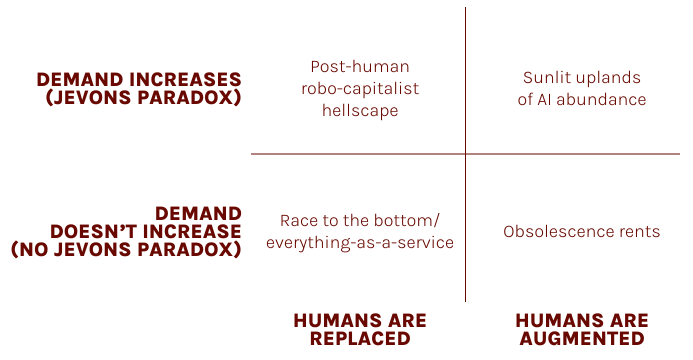
As an employee, you might begin to worry if you’re in a role or industry on the left side of the chart, where humans will be replaced wholesale. The bottom left will become a particularly grim place to be. But it also leaves complicated questions for those working in industries on the bottom right. What view do you take about the growth potential of those in the top right compared to those in the bottom right? Will the top-right industries race away, growing much faster? Do you risk being stuck in a dead-end industry, with the best outcome being the capturing of obsolescence rents as part of a smaller and older workforce, the future equivalent of today’s COBOL programmers?
For business owners, the bottom left quadrant is scary; a race to the bottom against low-cost providers. The bottom right is concerning for the same reason as it is for employees: the risk of long-term stagnation. But the top left is a capitalists’ dream; lots of growth and no pesky humans to slow things down. Expect lots of investor attention on that quadrant, for good and for ill.
That leaves the top right. It’s an exciting place, that lots of people want to play in, but even here there are pitfalls. Can you adapt to change as quickly as you need to? Is the AI-augmented version of your role something that’s still fulfilling, or are you reduced to a decerebrate AI overseer, forced to work at the pace of a machine, a “reverse centaur” as Cory Doctorow puts it? Does AI rip out the craft from what you do, rather than feeling like a superpower? As either a business owner or an employee, are you able to ride the wave of growth rather than being swept away by it?
Giving names to the quadrants sums up roughly how I’m feeling about them, looking ahead to a potentially AI-disrupted future:
Jevons, for what it’s worth, was right about coal. British coal consumption quintupled in the fifty years after he wrote The Coal Question. But the miners themselves, and the environment, paid a terrible price for it. I’m not sure whether I’m right about the industries I work in, but I’m sure as hell hoping I’m able to stay in the top right – and that the future is rosier for them than it was for coal.
Add a comment